01
Start from your baseline
Establish where your vocabulary stands today and connect every practice session to your Air Force goal, so your study plan targets what actually needs work instead of what already comes easily.
ASVAB Word Knowledge Masteryby Jordan Ellis
Focused vocabulary practice for Air Force applicants
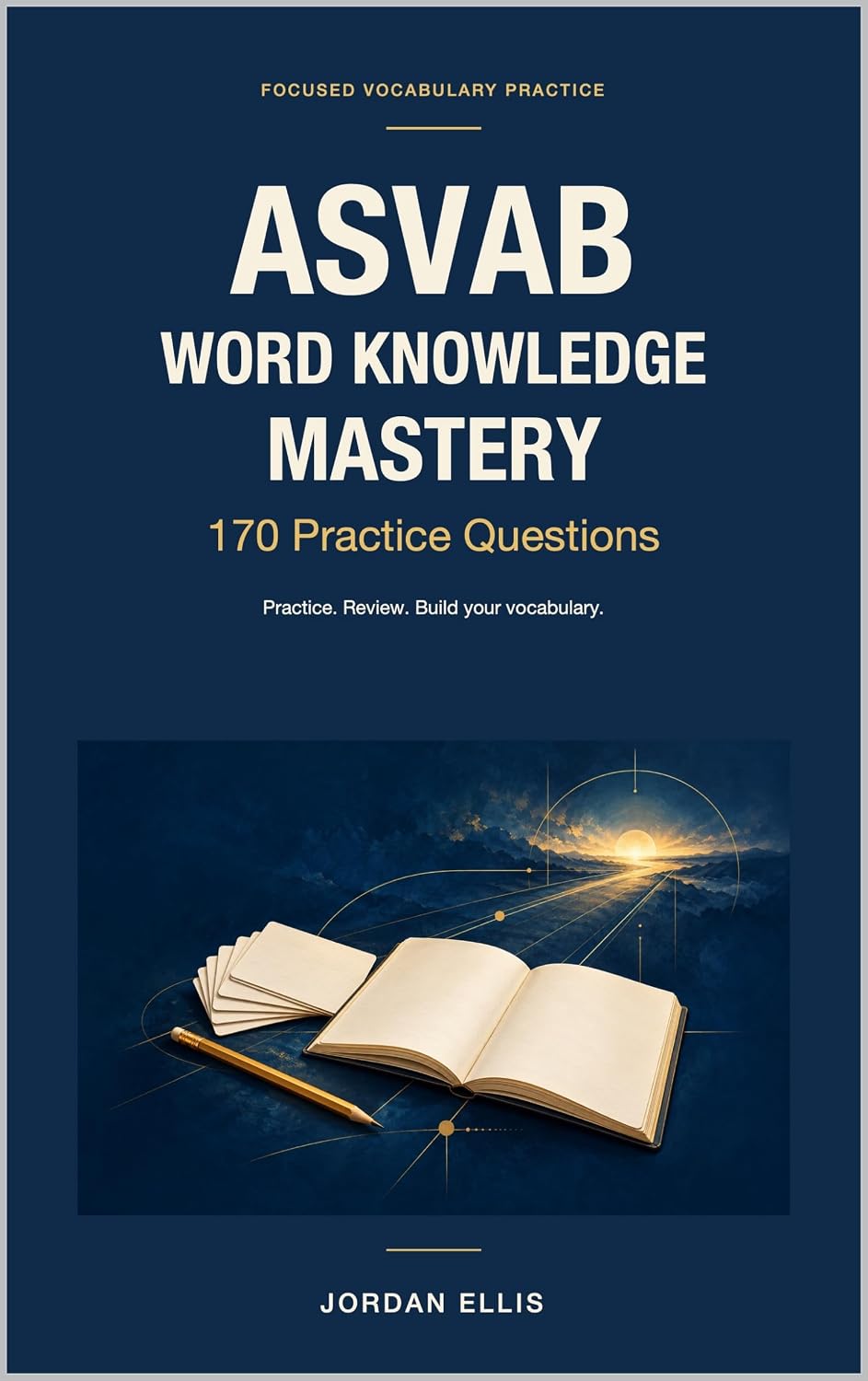
ASVAB Word Knowledge Mastery: 170 Practice Questions
by Jordan Ellis
Word Knowledge can be one of the trickiest parts of the ASVAB: unfamiliar terms, near synonyms, and misleading answer choices, all under time pressure. This ASVAB Word Knowledge practice book replaces random memorization and blind guessing with practical methods you can apply across the whole exam.
Inside the book
The ten chapters move step by step from foundational techniques to realistic rehearsal. Rather than simply completing questions and moving on, you learn to examine errors, identify patterns, and direct your study toward the areas that need the most attention.
01
Establish where your vocabulary stands today and connect every practice session to your Air Force goal, so your study plan targets what actually needs work instead of what already comes easily.
02
Work through original questions that ask for the closest meaning, including near synonyms and commonly confused words that are easy to mix up when the clock is running.
03
Word parts are useful supporting evidence, not a magic key. Practice recognizing prefixes and roots without overusing them or guessing blindly from a single syllable.
04
Learn to read the sentence around a word and use those clues to narrow down possible meanings before you even look at the answer choices.
05
When a word is completely new, blind guessing wastes the question. Build practical habits for reasoning through vocabulary you have never seen before.
06
Strengthen retention with a mistake-driven review plan, then progress from focused drills to mixed and timed practice that mirrors exam conditions.
The approach
“Make every study session count.”
Random memorization and blind guessing are exactly what the book sets out to replace. Its ten chapters build on each other: you establish a baseline, drill one skill at a time, log and review your mistakes, and only then test yourself under mixed and timed conditions.
For anyone assembling an ASVAB vocabulary study plan for Air Force applicants, that sequence is the core idea. Each round of practice ends with a look at what went wrong and why, so the next session starts where the last one fell short.
The goal is a useful vocabulary core instead of endless word lists — methods you can rely on when the question in front of you is one you have never seen.
Who it is for
ASVAB Word Knowledge Mastery was created around the needs of Air Force applicants. If any of these sound like you, it may be a fit:
Reader questions
The ASVAB’s Word Knowledge subtest checks how well you understand word meanings. In general terms, you see a word, often in a short sentence, and choose the answer closest in meaning. Exact subtest details can change, so always confirm them in official ASVAB materials; this book concentrates on practicing that skill with original, closest-meaning questions.
It was created around the needs of Air Force applicants preparing for ASVAB Word Knowledge, especially anyone who wants structured practice instead of unstructured memorization. No prior system is assumed; the early chapters help you establish your current baseline first.
The book contains 170 original practice questions, each written for this book rather than collected from elsewhere, and they progress from focused drills to mixed and timed practice.
The book builds retention through a mistake-driven review plan: instead of finishing a set and moving on, you examine errors and look for patterns. One practical way to do this is a simple ASVAB vocabulary mistake log — the word you missed, the answer you chose, the correct meaning, why you missed it, and a date to try it again.
A prefix or root is a clue, not proof. Knowing that a root relates to hearing, for example, rarely tells you a word’s full meaning or which answer is closest. The book teaches you to recognize word parts without overusing them, checking each one against the whole word, the sentence, and every answer choice before deciding.
Near synonyms share a topic but differ in strength, tone, or usage, so a related word is not always the closest match. “Reduce” and “slash” both mean to make something smaller, for instance, but they are not interchangeable in every sentence. The book’s questions train you to tell near synonyms and commonly confused words apart before you commit.
The book follows a repeatable sequence: establish a baseline with early practice, work focused drills on one skill at a time, review your mistakes, then move to mixed and timed practice that mirrors exam pressure. You can repeat that cycle each week, aiming every session at the areas that need the most attention.
The book covers identifying the closest meaning, using prefixes and roots wisely, reading contextual clues, telling near synonyms and commonly confused words apart, handling unfamiliar vocabulary, and strengthening retention through a mistake-driven review plan. Its ten chapters move step by step from foundational techniques to mixed and timed rehearsal.
Book and author
ASVAB Word Knowledge Mastery: 170 Practice Questions is Jordan Ellis’s guide to structured ASVAB vocabulary practice for Air Force applicants — the questions, the methods, and the review framework in one place.
If you want structured vocabulary preparation built around the needs of Air Force applicants, this book gives you the questions, the methods, and the review framework to make every study session count.